Forage Fish Monitoring
Forage Fish Monitoring
Project Lead: Peter Haase
Project Partners: The Salish Sea School, Northwest Straits Commission, Washington Department of Fish and Wildlife, and Northwest Straits Foundation
Project Years: 2012 - Present
Project Overview: Forage fish are a critical food source for seabirds, salmon, and marine mammals. Forage fish surveys identify where and when surf smelt and Pacific sand lance spawn on beaches and examines annual variations and potential trends in the spawning population. Forage fish surveys also provide a great opportunity to educate beach goers and school groups about the importance of forage fish and beach habitat.
This project is part of a larger collaborative effort to collect forage fish data across the Puget Sound region. We have a group of trained volunteers that go to various beaches several times a month to "survey" for surf smelt eggs. Surf smelt are "forage fish" that are about 6 " long and spawn (lay and fertilize eggs) in large numbers on sandy/gravelly beaches at the high tides. After two weeks, some of the eggs hatch into tiny fish and get back out into the water to grow and prosper and sustain the food web of life!
We collect samples of sandy gravel, process the gravel through sieves and a swirling bowl of water, and finally capture any eggs in a jar. We also document the beach location and conditions, such as amount of shading and the amount of restoration. The eggs can be examined with microscopes to determine how many there are and how close they may be to hatching. Eventually the eggs and all of the paperwork go to the Washington State Department of Fish and Wildlife.
Our work provides an inventory of how much spawning and hatching there is, and where. Beaches with documented spawning are well protected by regulations from any disruptions. Our data also can show long term trends and alert agencies to possible problems and places where some restoration with better gravel or shade could enhance spawning and hatching success.
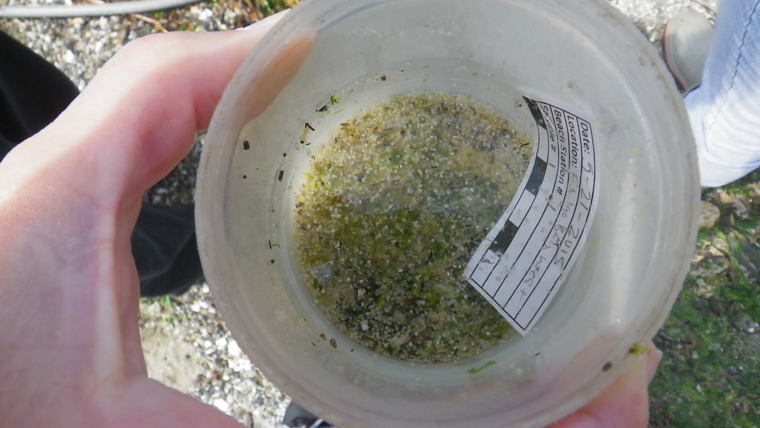
Surf smelt eggs collected in sediment sample

Forage fish survey volunteers processing samples collected on the beach